NEAR LIGHT WE SHINE: BUDDHIST CHARITY IN URBAN VIETNAM
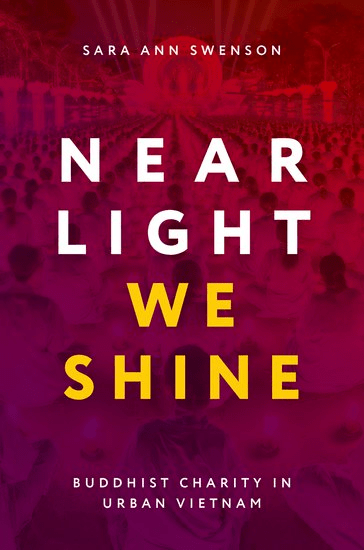
Description
Buddhists in Vietnam are addressing humanitarian needs by popularizing charity. Vietnam’s rapid urbanization has intensified social service demands while straining public infrastructure. In response, charity volunteers are building roads, subsidizing medicine, and giving away food. Near Light We Shine draws on two years of ethnographic research conducted in Ho Chi Minh City to analyze why and how people join these grassroots movements.
Volunteers adapt practices from Vietnam’s dominant religion—Buddhism—to attract donors and advocate for different programming styles. However, these groups also clash over the ultimate purpose of giving. Volunteers approach both Buddhism and altruism in different ways depending on their personal values and demographic communities. These communities include low-income day laborers, elderly women, Buddhist nuns, urban migrants, college students, and queer men. Volunteers promote altruism by citing the proverb, “What is near ink, darkens; what is near light, shines.” They use this axiom to distinguish themselves as good people “with heart” [co tam], whose charities are more caring and ethical than other organizations. Disputes over who practices true charity are rooted in different phenomenological and ontological experiences of how altruism influences the world. Volunteers promote distinct Buddhist cosmologies that are traditional, pro -socialist, skeptical, queer, modern, scientific, magical, and often at odds with one another. Altogether, Near Light We Shine provides unprecedented insights into how Buddhism is an adaptable resource for people building communities and working for change in Southeast Asia.
Available for order at Oxford University Press, Amazon, and other online booksellers!
FIGURES OF BUDDHIST DIPLOMACY IN MODERN ASIA (Jack Meng-Tat Chia, editor)

Description
Redefining how we understand diplomacy, Figures of Buddhist Diplomacy in Modern Asia reveals Buddhism as a dynamic force in shaping international relations. This groundbreaking open access book highlights individuals-including monastics, laity, political leaders, and royalty-who have strategically employed Buddhist objects, teachings, and networks to forge transregional ties and influence global politics.
Introducing the concept of Buddhist diplomacy, the book traces how Buddhism has been mobilized for soft power, cultural exchange, peacebuilding, and even geopolitical manoeuvring. From spiritual ambassadors like Taixu, Thich Nhat Hanh, and Hsing Yun to world leaders such as the Dalai Lama, Narendra Modi, and Xi Jinping, the twenty-two essays illuminate the surprising ways Buddhism has intersected with modern statecraft.
Blending historical depth with contemporary insight, this volume invites readers to rethink diplomacy not only as negotiation and policy but also as a terrain where religion, culture, and global power converge.
(I am honored to be the contributing author on Thầy Thích Nhất Hạnh’s legacy of Buddhist diplomacy. Figures of Buddhist Diplomacy in Modern Asia is available open access! Download a FREE copy of my chapter “Thích Nhất Hạnh: A Mission of Mindfulness” here.)
 Sara A. Swenson